@Geek
I understand.
A 'hot wallet' is any wallet where the private keys are kept on a device connected to the internet.
A 'cold wallet', including your trezor, paper wallets, or my laptop with radios removed, is any way of storing the private keys without access to the internet.
You seem to have encountered the crux of the problem with cold wallets is that they cannot independently communicate with the network to make transactions or check balances.
Here is the solution:
For checking balances we use a view only wallet, which is connected to the internet, but does not have the private keys required to sign transactions.
For sending transactions, a view only wallet can generate an unsigned transaction, which it then communicates to the cold wallet by qr code (or sd card, but qr is more secure), the cold wallet uses the private keys to sign the transaction and returns the signed transaction to the view only wallet by qr, the view only wallet then broadcasts it to the network!
So whether you follow my method, or you use a trezor, the flow is essentially the same. Its a similar process for any blockchain. A good software (I recommend feather) will abstract away most of the complexity and just require you to scan a couple of qr codes for every transaction.
Your idea to use a hotwallet for a small pocketmoney fund and reload it from a cold wallet is smart because you can spend money without going through the cold signing flow, but most of your money is controlled by strictly offline private keys.
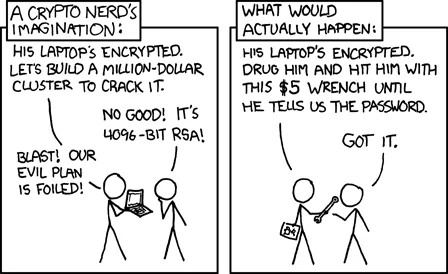
In general a hardware wallet, or a cold wallet, is a security necessity, although often also a false sense of security! Although in my opinion using a Trezor, Ledger, etc... might seem like the easier option but they really add nothing, at the expense of some really severe limitations. You can only use the software they come with, which for example, rarely supports xmr. They claim to have the ability to wipe your private keys completely from the device, but you have to trust that, whereas in my perception tails is more reliable since it was working before crypto caught on and its the standard for darknet ops. Finally, the update process usually requires a usb cable to connect to a network connected device. But your trezor was exposed to your seed phrase already! This is NOT COMPLIANT with the strictest air gapped security standards and I would not trust it with my money!
I have one more tip for you (although idk shit about apple apart from that its bad):
You can hash an entire software and compare it to the hash published on official sources if you need to check whether the software has been changed.