
Lounge Started Jun 9, 2026 11:53 PM

XNS: eXile Name System

16 replies - 221 views - 5 thanks - 1 tippers - 7 watchers

Jun 9, 2026 11:53 PM
#1
monero xns dns

Let me introduce XNS, the eXile Name System.

XNS is a name system built directly on Monero. It has no separate blockchain, token, premine, treasury, validators or governance system. Monero is its history, clock and only source of truth.

The Internet gave people the ability to publish and operate their own services, but the names through which those services are reached are still rented from institutions. You may own the server and every byte on it, while a registrar or platform retains the power to suspend, redirect or seize the name attached to your work.

XNS is an attempt to enfree names.

An XNS name belongs to an Ed25519 public key. A claim is an ordinary Monero transaction sent to a protocol-defined burn wallet. The transaction amount determines the lifetime of the name, while tx_extra contains the name and owner public key directly.

The protocol wallet has a valid private view key, allowing its incoming transactions to be discovered, but its spend public key is the order-2 Edwards point (0, -1). There is no valid private spend key behind it. XMR sent there cannot be recovered by anyone.

One year costs 0.01 XMR, defined as 262800 Monero blocks.

An XNS indeXer scans the protocol wallet and deterministically reconstructs the registry from Monero. Its database is only a cache. It can be deleted and rebuilt from the chain. Anyone can run an indeXer, and applications are expected to let users choose which one they use.

XNS has no update or transfer operation. If a name is active, only another claim using the same owner key can renew it. A different owner cannot replace it. When the name expires, it becomes free again.

The absence of transfers is deliberate. Selling a cryptographic identity means selling a private key, but the buyer can never know that the seller did not retain a copy. Without trustworthy transfers, there is no trustworthy resale market, which removes the practical reason to collect names for resale.

XNS is now live on mainnet and stagenet. The protocol, implementation and documentation are public, and I would appreciate review from the community.

Website: https://xns.rocks
Documentation: https://xns.rocks/docs
Source code: https://github.com/exilens/xns
Web lookup: https://ui.indexer.xns.rocks
Bare indeXer API: https://indexer.xns.rocks
Donate: https://xns.rocks/donate

Signature

Tengri biz menen

5 thanks - 1 tippers - 7 watchers

Replies

Page 2 of 2 - 16 total
Jun 10, 2026 3:50 AM
#12

i just asked the llm cause idk wtf about what but that's always refreshing to see contributions like these
and seems like there are some confusions in the thread regarding XNS and DNS so llm was like:

2141253

The confusion

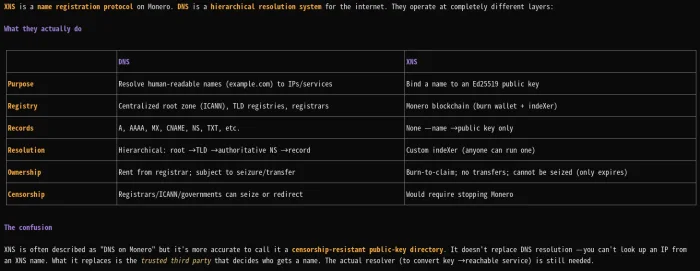
XNS is often described as "DNS on Monero" but it's more accurate to call it a censorship-resistant public-key directory. It doesn't replace DNS resolution — you can't look up an IP from an XNS name. What it replaces is the trusted third party that decides who gets a name. The actual resolver (to convert key → reachable service) is still needed.

What's missing from XNS as "DNS"

  1. No record types — can't store A/AAAA/MX/SRV records
  2. No hierarchical delegation — every name is flat
  3. No resolution protocol — no equivalent of dig or nslookup standards
  4. No DNSSEC — integrity comes from Monero blocks, not cryptographic chain of trust
  5. No caching/TTL — each indeXer decides freshness
  6. No reverse lookup — no PTR mechanism
  7. No subdomain supportfoo.bar.name may not work (OP didn't specify subname structure)

Where XNS excels

  • Tor/I2P — onion addresses are already Ed25519 keys; XNS gives them a memorable name that can't be seized
  • PGP/WOT — replace WOT with a Monero-backed claim of eravsar → key
  • Self-sovereign identity — your name is provably linked to your key, no registrar involved
  • Censorship-resistant publishing — even if a government seizes your DNS domain, your XNS name still points to your key

Summary

XNS doesn't compete with DNS — it competes with registrars and certificate authorities. You'd still need DNS (or Tor) to get packets to a destination. XNS tells you who owns the name; DNS tells you where the server is. They solve different problems.

2 thanks - sepia, eravsar - 0 tippers
Jun 10, 2026 3:57 AM
#13

@SpinningCat it is still a "domain name system" even if not focused on traditional networking, instead it is better to call it that it considers cryptographic identifiers as the network unit rather than IP addresses thats assigned to you by your ISP. Just like how I2P, Reticulum and Tor does it. Thats the cypherpunk way and XNS is made for that. Thank you for checking it out.

Signature

Tengri biz menen

2 thanks - sepia, SpinningCat - 1 tippers
Jun 10, 2026 5:38 AM Edited Jun 10, 2026 5:38 AM
#14

@eravsar That's interesting, and I agree that what you are building adds real value and I'd definitely prefer to use it than existing solutions. It seems unnecessary to limit it just to tor and i2p because everyone needs DNS but tor/i2p are not worth it for most websites. If you could find a way to extend it then I'd definitely use it for my http links, even if it requires the user to run a daemon. In the future I see more people relying on technology like this to evade access censorship because digital ID is an active threat.

1 thanks - eravsar - 0 tippers
Jun 10, 2026 9:28 AM
#15

@eravsar

This is a fantastic idea.

I've been looking at ARweave, storj, Nostr, and filecoin.

One year costs 0.01 XMR

Sadly, $300 per year for a domain name excludes me, and always will.

Who sets this price, and is it variable ?

If variable, based upon which market conditions ?

1 thanks - eravsar - 0 tippers
Jun 10, 2026 9:36 AM
#17

@CharliePrimero $3 a year lol. it is a protocol constant and always will stay as 0.01XMR, it is a burn transaction, no one makes profit, there is no market. to learn more on how XNS works see xns.rocks/docs

Signature

Tengri biz menen

2 thanks - SpinningCat, H1XMR - 1 tippers

Post A Reply

You must be logged in to reply. Login or register.